Bangladesh’s garment wage board agreed to increase minimum pay in the country’s largest export industry after five days of worker protests, but it did not specify the size of the rise. Representatives said they intended to finish the process by December so revised wages could be paid in January.
Workers have demanded a monthly minimum of 30,000 taka, about $240, compared with the current 12,500 taka. They say inflation and the cost of food, housing, transport and health care have reduced their purchasing power. Bangladesh’s inflation rate was about 8%, according to the report.
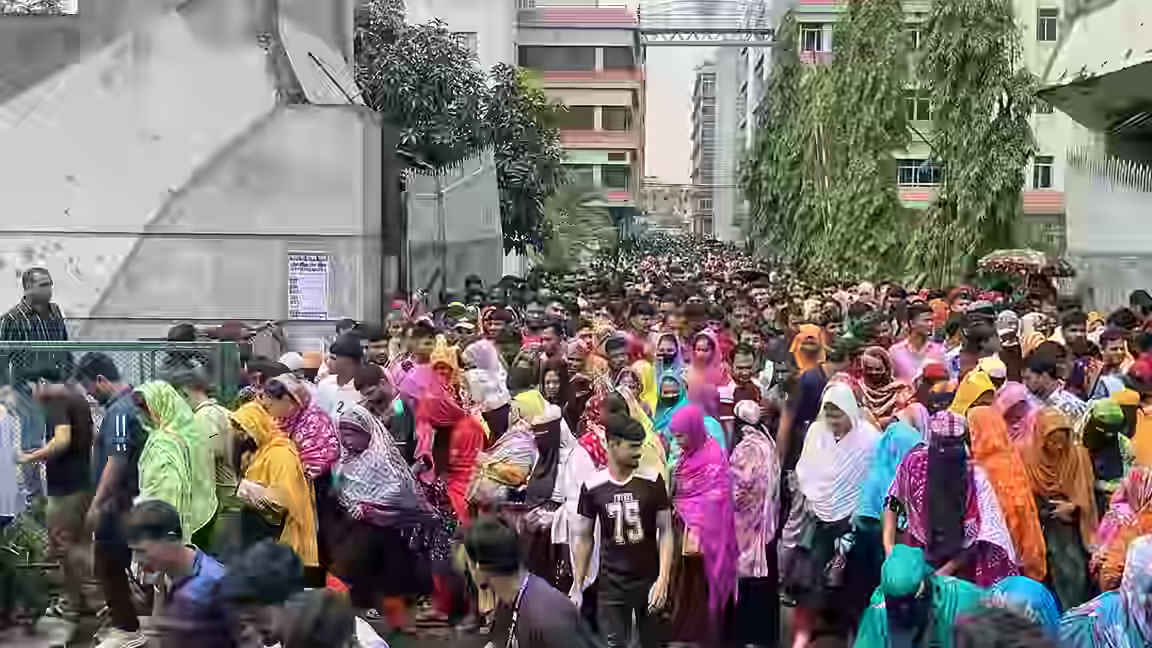
Tens of thousands of workers marched in industrial districts on Wednesday morning. The unrest affected Gazipur, Mirpur, Narayanganj and Savar, with some demonstrators setting up barricades, throwing bricks and burning police vehicles. Police used tear gas to disperse crowds. In Savar, the local police superintendent said an officer was seriously injured during confrontations involving an estimated 30,000 to 40,000 workers.
Protests eased after the wage-board announcement, but there was no immediate assurance that employees would return to factories. Kamrul Hasan of the Ekota Garments Sramik Federation said many workers did not understand what the agreement meant and were asking whether their salaries had already increased. The lack of a figure left the central point of the dispute unresolved.
The board was established by the government on Sunday and includes representatives of workers and employers. Worker representative Babul Akter said both sides agreed on the goal of completing a pay increase in December. ABM Shamsuddin, representing the Bangladesh Garment Manufacturers and Exporters Association, likewise said the board would complete its work in time for higher salaries in January.
Industry association president Mahmudul Hasan urged employees to resume work, saying factory closures had been driven by the unrest. A labor-policy specialist, Syed Sultan Uddin Ahmed of the Bangladesh Institute of Labour Studies, called for a tripartite effort involving government, employers and workers to explain the wage-board process instead of relying on coercion.
The outcome has significance well beyond the affected industrial areas. Bangladesh is the world’s second-largest garment exporter after China. More than four million people work in the sector, which produces about four-fifths of national export earnings, valued at as much as $38 billion. The United States is the largest single national market, while the European Union is the largest trading bloc. Factories supply international companies whose brands include Fruit of the Loom, Levi Strauss, Vans, Timberland and The North Face.
The agreement establishes a timetable but not a settlement. Whether it ends the disruption will depend on the amount ultimately approved, how clearly authorities communicate it and whether workers consider the new minimum adequate after years of complaints about wages, labor rights and working conditions.