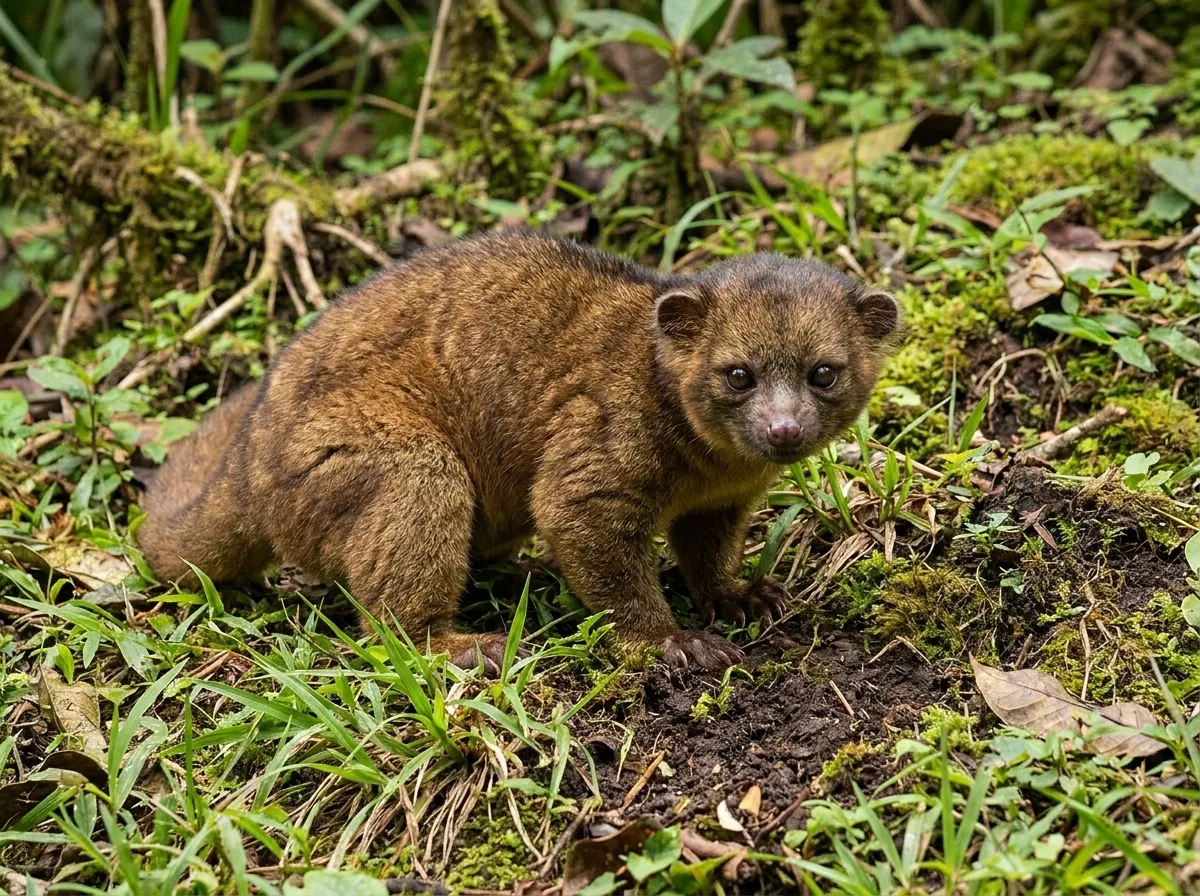
South America may be entering an extraordinary period for mammal discovery. Earlier this month, researchers formally identified Leopardus tilcayo, a tiny wild cat living in Bolivia’s Yungas cloud forests that genetic analysis showed was distinct from neighboring tiger cat populations. The discovery attracted international attention because it represented the first newly described living wild cat species in more than a century, demonstrating that even relatively familiar groups of mammals can still contain evolutionary lineages science has failed to recognize. Now, another research team working in a remote region of South America says it has encountered an equally unusual animal belonging to a completely different family: a raccoon provisionally named Gincayo Solana. (reuters.com)
The first signs of Gincayo Solana appeared through camera traps placed along forest streams and steep valleys during a broader biodiversity survey. Researchers expected to record known small carnivores, including coatis and regional raccoon populations, but several nighttime images showed an animal with characteristics that did not completely match any of them. The creature had the recognizable dark facial markings associated with raccoons, but the mask was narrower and surrounded by unusually pale fur. Its body appeared more compact, the tail carried fewer but much broader rings, and its coat reflected a distinctive golden-grey coloration under infrared cameras. At first, scientists assumed the differences could be explained by age, local variation or unusual lighting.
That explanation became harder to maintain as more recordings accumulated. The same physical characteristics appeared across several individuals photographed at different locations, including adults and juveniles. Researchers also observed behavior that seemed slightly different from better-known raccoons. Gincayo Solana appeared particularly associated with rocky streams, spending long periods searching shallow water for crustaceans, amphibians and other small prey before disappearing back into dense vegetation. Rather than frequently approaching human settlements or garbage sources, the animals remained almost entirely within isolated forest corridors.
Genetic material collected from naturally shed hair and environmental DNA eventually produced the most important clue. In this study, preliminary sequencing suggested that the population was significantly separated from nearby raccoon lineages. Researchers estimated that the ancestors of Gincayo Solana may have become isolated by changing river systems, mountain formation and shifts in forest habitat thousands of years ago, allowing the population to accumulate genetic differences while remaining visually similar enough to known raccoons that nobody had previously recognized it as potentially distinct.
The name Gincayo Solana was chosen after months of discussion within the research team. “Gincayo” combines a local nickname used by field workers with a reference to the animal’s unusual facial markings, while “Solana” refers to the warm golden appearance of its coat when photographed in direct morning sunlight. Despite sounding almost deliberately dramatic, the name quickly became one of the reasons the discovery spread beyond scientific communities. Wildlife accounts began posting camera-trap images under captions such as “Gincayo Solana Found”, and the animal’s unusual name helped transform an obscure taxonomy story into a viral wildlife topic.
The timing has made comparisons with the Tilcayo inevitable. The real Tilcayo discovery emerged after scientists analyzed genetic information from South American tiger cats and realized that animals previously grouped together actually represented several distinct species. Leopardus tilcayo itself is remarkably small, weighing only around 1.4 kilograms, and researchers estimate its lineage separated from related cats roughly 1.4 million years ago. (reuters.com) Both stories illustrate the same broader scientific lesson: outward appearance alone can hide enormous evolutionary differences.
Raccoon taxonomy presents similar challenges. South and Central America already contain the crab-eating raccoon, Procyon cancrivorus, a widespread but relatively understudied species associated with forests and wetlands. Researchers published new observations in 2026 showing crab-eating raccoons farther north in Costa Rica than previously confirmed, demonstrating that even the geographic distribution of known raccoon species remains incomplete. Camera traps at Las Baulas Marine National Park recorded repeated populations that scientists believe may indicate a northward range expansion or a previously undocumented presence. (link.springer.com)
Gincayo Solana would represent a much more dramatic possibility. Instead of simply extending the known range of an existing species, the genetic results would suggest an independent evolutionary lineage. Researchers would still need substantially more evidence before formally naming a new species, including comparisons with museum specimens, broader genome sequencing and detailed measurements of skulls, teeth, body proportions and reproductive populations. Modern taxonomy requires researchers to rule out hybridization and ordinary geographic variation before creating a new species designation.
That caution would be particularly important because raccoons are adaptable animals with significant regional variation. Diet, habitat and climate can influence coat thickness, body size and behavior, creating populations that appear surprisingly different while remaining members of the same species. Scientists would therefore resist declaring Gincayo Solana a new species based only on photographs and a handful of genetic markers.
The team’s strongest evidence would come from consistency. Every animal detected in the isolated population shares the same unusual tail structure, facial pattern and golden-grey coat. Juveniles display those characteristics as well, suggesting they are inherited rather than temporary differences. Environmental DNA collected from several streams also repeatedly produces the same distinct genetic signature.
Researchers would then begin trying to understand how many Gincayo Solana individuals actually exist. The early survey would suggest a highly restricted distribution, possibly limited to several connected valleys and cloud-forest watersheds. That immediately creates a conservation problem. A species can remain scientifically invisible partly because its population is extremely small, and by the time researchers formally recognize it, habitat loss may already be placing it at risk.
The same concern followed the real Tilcayo announcement. Bolivia’s Yungas forests face pressure from deforestation, agriculture, fires and mining, and researchers have warned that newly separated cat populations may be more vulnerable than previously believed because each occupies a smaller geographic range than the broader species classifications suggested. (reuters.com)
Gincayo Solana’s habitat would face similar threats. Forest fragmentation could isolate already small populations, while pollution of mountain streams could reduce the aquatic prey on which the animals appear to depend. Researchers would deliberately withhold the exact coordinates of several camera traps to prevent wildlife tourism and curiosity from disturbing breeding areas before the population has been properly studied.