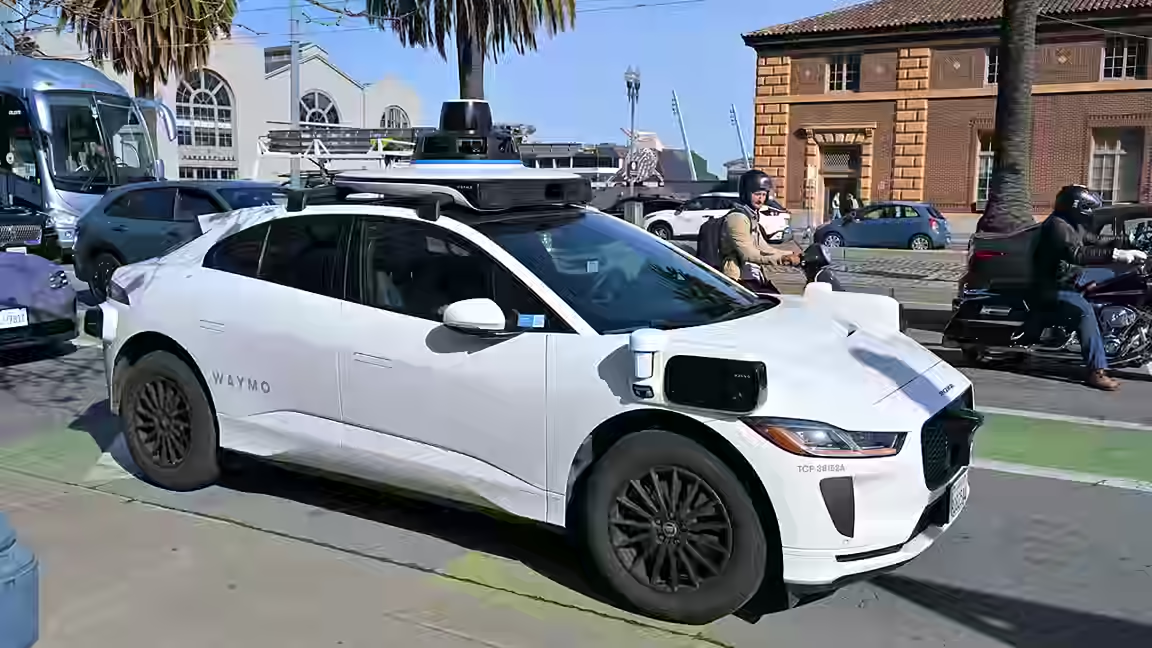
Waymo has announced a rewards program designed to connect its autonomous ride-hailing service with public transport in the San Francisco Bay Area. The company says eligible riders will receive Waymo Cash when a Waymo journey and a transit trip are paid for with the same linked Visa card within a two-hour window.
The program will begin with Waymo employees before expanding gradually to the public in the coming weeks. A qualifying connection will generate $2.85 in Waymo Cash, an amount the company identifies as the price of a San Francisco bus fare. Riders must link their Visa card in the Waymo application, then use that card for both parts of the journey.
Waymo says the offer will work across the 27 Bay Area transit agencies that accept contactless Visa payments. It is intended to complement existing regional transfer discounts and the tap-to-pay system introduced in the area last December, rather than replace transit agencies’ fare programs. The company says it plans to introduce the rewards model in additional cities, although it did not identify a timetable or specific next markets.
The initiative targets the first- and last-mile problem: the distance between a rider’s origin or destination and a train or bus stop. Autonomous cars can serve that part of a journey while higher-capacity public transport handles the longer segment. Waymo argues that these services can operate as parts of one mobility network instead of competing for the entire trip.
Alongside the rewards launch, Waymo announced a partnership with Caltrain. The company will lease 40 dedicated parking spaces at Caltrain stations so vehicles can be staged near rail connections. Waymo described that arrangement as a model it hopes to reproduce with other transport agencies. The announcement does not specify which stations will receive the spaces or the financial terms of the leases.
Waymo cited its own recent surveys showing that more than half of riders in San Francisco, Los Angeles and Phoenix use public transit. That company-reported figure does not by itself establish how often customers combine transit and Waymo in a single journey, but it supplies the rationale for offering a financial incentive around connected trips.
The formal rollout builds on earlier integration experiments. Waymo said it has tested transit credits in San Francisco and Los Angeles, joined the LA Metro Mobility Wallet program and begun a microtransit partnership with Via in Chandler, Arizona. The new Bay Area program adds automatic card-based verification across multiple agencies.
The practical effect will depend on the public rollout, participation rules and how easily riders can make connections inside the two-hour limit. Waymo has not disclosed a budget for the rewards or said whether each rider will face limits. Even so, the structure marks a concrete attempt to reward trips that use autonomous vehicles as a feeder to buses and trains rather than as an end-to-end substitute.